A Snapshot Of Life in Trebetherick
- Brian Oaten - Born and Lived In Trebetherick 1939 to Today
THE HAVEN - 1906
In 1906 The Haven was built in Trebetherick as an 8 bedroom guest house, near the top of Worthy Hill, to provide accommodation primarily for golfers to visit the new St Enodoc golf course.
The 1901 CENSUS and Early Life in TREBETHERICK
There were eight households and one uninhabited house, 17 adults and 11 children. 1901 TREBETHERICK INHABITANTS were 3 farmers, John Wills, John Mably, Charles Mably. Humphrey Craddock a stone quarry mason, Ann White a shirt maker seamstress, The 2 coastguards were Benjamin Longworthy from Liverpool and William Clode, The Mably sisters Joanna and Harriet were elderly and retired but employed several labourers. One visiting migrant or in-service working family Cottell, husband, wife and 5 children, formerly of St Tudy and then Trevalga, listed with 75yr old widowed farmer, John Mably.
No road between Trebetherick and Polzeath - No road across Polzeath Beach
At this time there was no road between Trebetherick and Polzeath only a pedestrian/pony track through the six fields between the two villages. The main way in and out of Polzeath was via Dunder Hill. An elderly gentleman visiting us at The Haven could remember using the track to walk from Trebetherick to Polzeath and having to open and close the six field gates to get there. The residents of Polzeath would make journeys north and eastwards up Dunder Hill by pony and trap or cart and horse to market, for business, or for visiting further afield. It was customary for passengers and children to walk up the hills to lighten the load for the pony. On the return journey, when reaching Port Quin Cross, being mostly downhill and flat from there to the top of Dunder Hill, Polzeath, it was possible to give the ponies a good gallop. Those flat fields are called Galloping Fields. In summer, day trippers to Polzeath beach, for example the St. Mabyn and St. Kew Sunday School or feast day outings, travelled by horse drawn charabanc, (open cart or coach with bench seats). On arrival the horses were stabled, fed and watered at F Male’s Stables and Picnic Tea Rooms, charabancs stabled, cars parked (photo) (no relation to Trebetherick Higher Farm Harry and Basil Male )
F MALE’S Stables and Tea Rooms - Before the road was built

The Polzeath Chapel was moved into a purpose built shed in 1898 using a corrugated iron roof and became known locally as the Tin Tabernacle at Chapel Corner, (1920 photo). In 1932/3 the new chapel was built further away from the corner to allow for road improvements.

DAYMER LANE - SAND CARTING TRAFFIC

- 1920-40s - Sand Carter With Pony Nearing Lower Farm and the PO at The Top Of Daymer Lane

Tenant farmers’ manorial leases to Trewornan and Roscarrock required 12 cart loads of sea sand to be applied to every cultivated acre. The carters sold sea sand in 1930 for 1/6 per load, 6 loads being gathered at each tide, (photo). Halfway down Daymer Lane a large horse trough was built, fed by a spring (photo). This was essential in the 19c for the many horses pulling the heavy carts loaded with sand up the lane. Several cottages were built backing onto Daymer Lane (enjoying lovely south facing, sheltered gardens), perhaps as many as 8 or 10, all but Cobb Cottage and Torquil Cottage are now gone.

BRIAN’S GREAT GRANDPARENTS CAUGHT IN THE 1881 or 1891 BLIZZARD
Brian’s great grandparents were returning in their cart from market in 1881 or 1891 with a quantity of supplies and meat when it started to snow. It soon became a blizzard and they could go no further. They had to unhitch the pony and leaving the cart where it was stuck, they led the pony and just managed to struggle home. The told of the snow drifts being so deep that sometimes they had to walk on the tops of the hedges. It was two weeks before the freeze thawed enough for them to return to fetch the cart. Rather surprisingly all their meat had remained frozen and none was spoiled!!
Richard Tellam-Hocking’s First Trebetherick Shop (please contact me if you have a photo of this little shop I would love to have one)
At the top of Polzeath Hill was a purpose built shop, double fronted with door in the middle, run by Ralph Tellem-Hocking’s father, Richard. In the summer they made ice-cream which his wife sold on the beach. When she needed more she waved a flag as a signal to her husband to bring down more supplies. At a later date this little building was re-purposed as the Polzeath doctors surgery.
Before 1928 Trebetherick Had No Mains Water and so The Haven was Self Sufficiant
Water Mains laid to Polzeath 1928, to Trebetherick also at the same time I think.

1941 WW2 Brian Oaten remembers as a child of two and a half being woken by his mother to be held up to the window to see the glow in the eastern sky which was Plymouth on fire during the WW2 blitz. It must have been particularly distressing for Mabyn as her husband Lewis, like many carpenters and shipwrights were working in Plymouth. In 1938 Lewis Oaten sensed that Hitler’s actions were becoming increasingly menacing and that things were changing in the building trade. He looked for alternative work and took a job in Looe as a shipwright making wooden launches for the Admiralty. Soon those with shipwright skills like Lewis and his colleagues were all required to go to Devonport and work in the Admiralty Dockyard which he did for the rest of the war.
1925 TREBETHERICK DUCK PONDS
Brian remembers, as a boy in the very cold winter of 1946, sliding on the several frozen Trebetherick duck ponds. They were on the road side of Higher Farm, close to the hedge, another was next to Elm Cottage. The one above Worthy House in the photo below was drained in the 1940s for road improvements.

Collage of duck pond 1925 and today 2021

Just above the Daymer Bay Garage was one of the village duck ponds which served as a watering spot for working horses, was drained in the 1930s after mains water was installed, making way for the new and larger Trebetherick telephone exchange. On the right is the gate into Ham Field, so called as it was the triangular shape of a ham.
1941
- 1941 - Brian Oaten age 2, inside the gate at the first Trelawney, Trebetherick, (built by his father Lewis Oaten and now renamed Pen-y-Bryn) having ridden with Brian’s grandfather John Oaten, from grandparent’s home ‘Kitts Hill’, St Kew.

- Lewis Oaten and his mother Mary (Polly) Oaten outside the house where they both were born, Kitts Hill, St Kew, with his son Brian Oaten.

- This photo could be Brian’s Grandfather, John Oaten, travelling from Kitts Hill, St Kew to Trebetherick sometime before 1932 on his pony and trap going down Dunder Hill and through Polzeath. The original Tin Tabernackle still in place at Chapel Corner before being re-built in its present day poition so the road’s steep and sharp corner could be widened.

THE HAVEN - 1950s
-
The Haven was bought by Mr Harrison but remained unoccupied for 3 or 4 years. In the mid 1950s it was bought by Brian’s parents, Mabyn and Lewis Oaten. Lewis was a qualified carpenter and builder employing several local people, using the stables as a storeroom and garage. Mabyn did bed and breakfast, taking overflow sleepers from St Moritz. One group of those guests was the Gill family. William T Gill was a financial director at Rolls Royce in Derby. The following year they brought down their friends and Mabyn was delighted to recount how she looked down from The Haven balcony at four Rolls Royces parked in the garden. ( see photo).
-
1943 Brian went to St Minver Primary School. His mother, Mabyn, took him on the back of her bycicle until he was old enough to walk there and back.
-
This is Brian’s pre-school letter to his grandmother Alice Jane Burne living at Southleigh, St Mabyn

-
Brian loved school and was full of admiration for the wonderful head teacher Mr Russel Lanxon and class teacher Miss Buse. Mr Lanxon was still the headmaster 30 years later who employed Brian as a teacher in about 1975.
-
In 1951 Brian went to Bodmin Grammar school. Transport was a taxi to Rock, bus to Wadebridge then the train to Bodmin.
-
During the next 20 years Mabyn and Lewis continued to improve to The Haven, including adding a sun lounge and installing central heating.

The Haven - 1970s
In the mid 1970s Mabyn and Lewis retired and built a bungalow on their south field next to The Haven, calling it Trelawney. They sold The Haven to their son Brian Oaten and his wife Jenny, teachers at St Minver Primary School and Port Isaac Primary School. We remember the old wooden tennis net posts with brass winders still lying up in the garage loft. MABYN AND LEWIS OATEN 1911-1990 Mabyn was born in St Mabyn and Lewis Oaten was born in St Kew, both in 1911. Lewis Oaten had trained as a carpenter with the Wadebridge builder, Lewis Brown. They built some of the early Greenaway estate houses before the Second World War. Lewis Oaten bought a small piece of land in Trebetherick from Harry Mail, and built his own bungalow which they named Trelawney. Basil’s father, Harry had bought Higher Farm of 180 acres and built a new farmhouse in 1930. The old farmhouse with sitting tenant was renamed Old Farm. Lewis and Mabyn Oaten married in 1938 and lived at Trelawney till the mid 1950s when they sold that bungalow and moved to The Haven, the bungalow was renamed Pen-y-bryn.
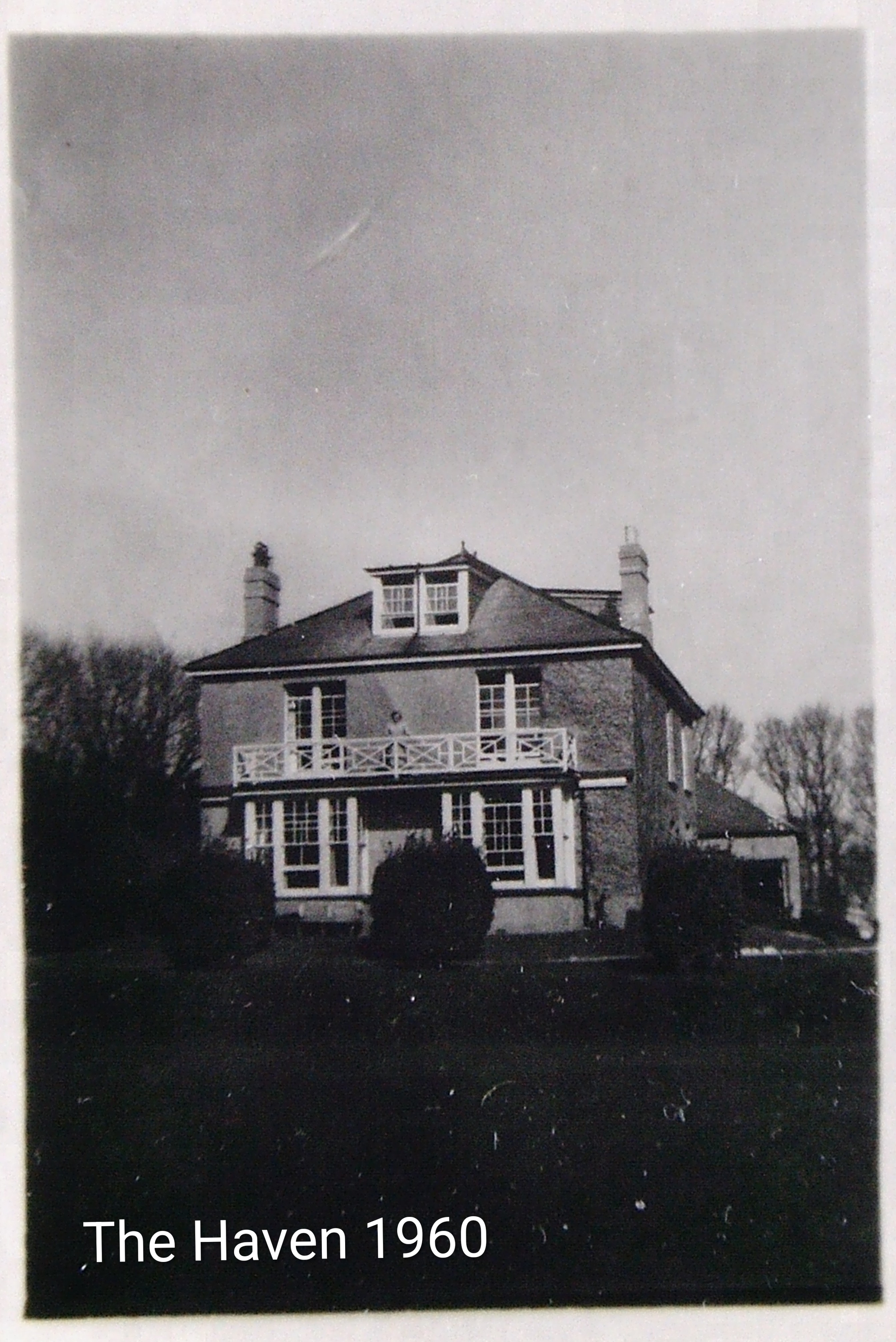
- The Haven 1960

- The Haven 1965

- 1967 Daymer Beach and Trebetherick Point from Brea

- 1965 Trebetherick from Brea

- On the main road through Trebetherick 1965 looking towards Brea,telephone exchange on left, the bus shelter has now been been moved to the other side of the road


- The Haven, Trebetherick, as it was when first bought by Lewis and Mabyn Oaten in the mid 1950s with first floor west-facing balcony. Mabyn did bed and breakfasts while Lewis, a carpenter, ran a small carpentry/joinery and general repairs business.

- This postcard was taken sometime 1930-1950. Note The Haven top right and the car on the beach.
BEFORE THE ROAD WAS WIDENED IN 1960s
- Looking uphill, at The Haven entrance on the right, Old Farm is the house roof you can just about see in the centre, with the old Daymer Garage building to the left, demolished for the road straightening and widening improvements in late 1960s.

DAYMER BAY GARAGE and WORKSHOPS
- The Daymer Bay Garage, was located at the junction of Worthy Hill and Daymer Lane, was operated by Norman Cleave, a motor car enthusiast and the father of Leadville Cleave and grandfather of Jon Cleave, from Port Isaac. The garage included workshops, garages, and a petrol pump. Norman also managed the Clock Garage at Rock. Below the garage on Daymer Lane, Worthy House was built and served as both a Post Office and a telephone exchange, playing a central role in the village’s communication.
View of the junction between Daymer Lane and Worthy Hill The gable end of the set of 4 garages

This was looking up, at the top of Worthy Hill, Daymer Bay Garage, might have been built before WW2 but it was derelict in 1956

At the top of Worthy hill, looking down, Daymer Bay Garage is on the right and The Haven entrance is on the left

Almost at the top of Worthy Hill, The Haven entrance is on the left with gate posts parallel with the original old road. Daymer Bay Garage is now gone.

1963 Aerial View of The Haven - showing Lewis Oaten’s newly constructed mahogany sunlounge
sheltered from north and east by mature Cornish elm trees - all died of the Dutch elm disease in 1970/80s.

Looking up Daymer Lane almost at the top, this was a set 4 garages with the post office on the right

1970s BILL TUCKER’S COACH TRIPS
Bill Tucker from Trewornan Farm, was a horse and coaching enthusiast and he used to conduct pleasure trips that passed by The Haven, sounding a long, shining copper coaching horn at corners and other suitable points along the route.


- Higher Trebetherick - Looking North - Before Road Widening 1960s

Higher Farm on Left - Shop on Right

New Telphone Exchange on right

- Worthy Hill

Looking North - Floraldene On Right

- Worthy Hill - Looking South - Floraldene on Left.
Before the building of Tide Race, Breafield and public footpath. Note the council wintertime piles of sand to grit the hill
- 1979 Daymer Beach, when it was a lovely sandy beach.



- The Haven itself was rendered on the outside using sand and shingle containing small shells, which were brought up from the beach by pony and cart. With one of these loads, the Trebetherick Point defense cannon was brought up for safekeeping. It was mounted in the front garden until 1999, when Naval historian Tim Parr, who was researching Henrician Cannons, visited. He was instrumental in arranging for its preservation and subsequent display at Prideaux Place, where its sister cannon from the Padstow side is also located.
THE TREBETHERICK CANNON - circa 16th centuary
This 3 pounder gun was mounted in the Trebetherick Battery at Greenaway, 20 feet above the High Water Mark, on the East side of the Camel Estuary, as part of the defences of Padstow. It is very badly corroded as it was exposed to salt spray in every gale in the prevailing South West wind for at least 200 years. It is thought that the guns on their wheeled carriage may have been kept in St Enodoc Church to be rolled out and up onto Greenaway when needed.
The gun was brought up from the Battery in the early 1900’s, by a farmer Mr. Barton, with his last load of shingle from Greenaway beach. The gun was set on a concrete plinth at the south west corner of The Haven in Trebetherick in 1906.
Brian Oaten kindly arranged with Tim Parr naval historian, for the guns safekeeping to be displayed at Prideaux Place, where it has been conserved and has now been mounted on a 1600 replica “bed and bracket” carriage, for display.
While the degree of corrosion makes it difficult to be precise about its date, or its history, based on its proportions and the shape of its trunnions it is considered likely that it was cast in the 16th century, and is therefore another early cast iron gun.
This gun, with the three “Finbankers, which lay in Pentire Farm, formed the Trebetherick battery, which was a part of the defences of the “Safe Haven” which was established in Padstow, in 1780, to shelter British ships being pursued by American Privateers, as described in the panel on the War of American Independence.


Unknown lady with Lewis and Mabyn Oaten in the front garden of The Haven by the Trebetherick Point cannon in the mid 1950s


